What Is a Sales Funnel? Stages, Metrics & How to Optimize

 Last updated:03/12/2026
 15 min read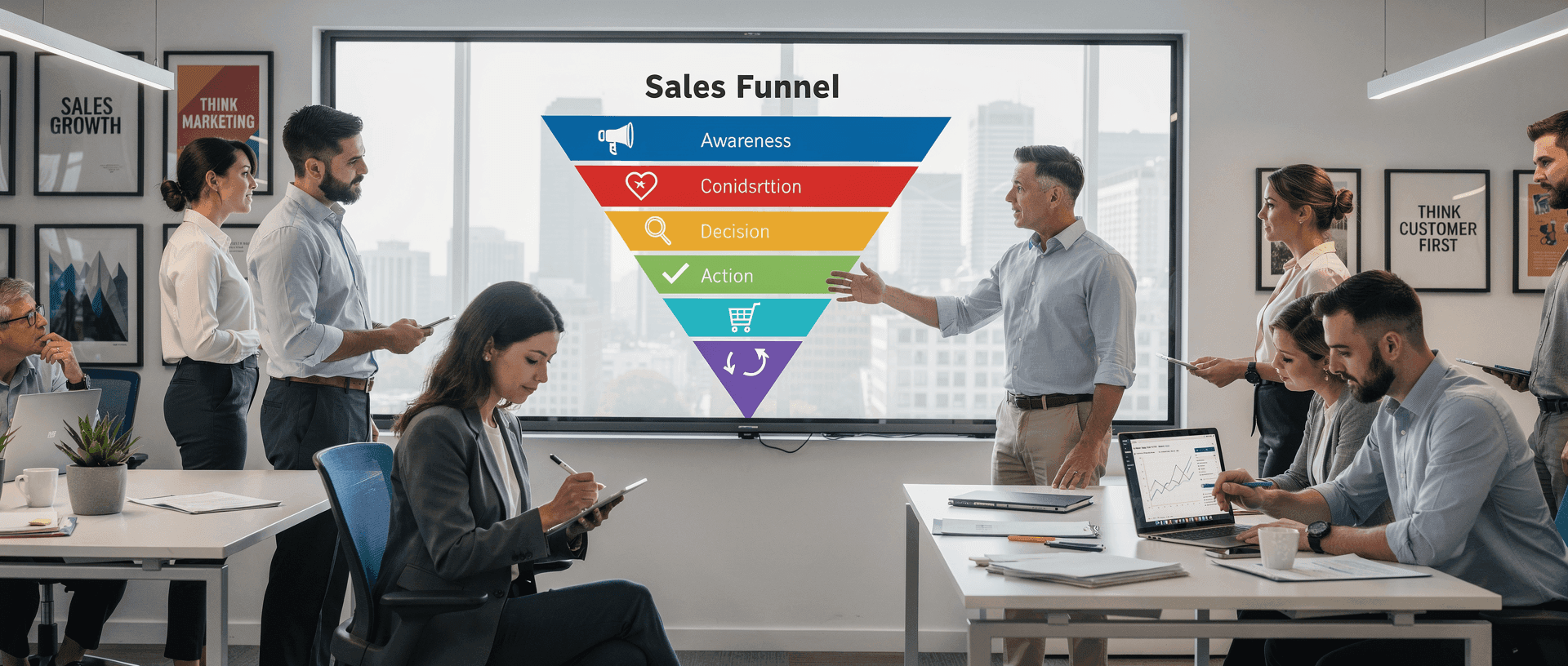
Have you ever spent money on ads, only only to see most potential customers leave your website without buying anything? It's a common problem. Many businesses lose money each year because they don't guide customers effectively through the buying process.
RemoteReps builds lean, efficient outsourced sales and support teams for 350+ brands, operating under SOC 2 controls since 2013.
This is where the sales funnel comes in. It's a clear map showing how a curious person becomes a paying customer. It's not just a fancy term; it's a strategic plan that helps successful companies stand out. By understanding and improving your sales funnel, you can boost sales, build customer relationships, and grow your business.
This guide will explain what a sales funnel is and its important steps. We'll show you how to create one for your business, whether you sell to other businesses (B2B) or directly to consumers (B2C). You'll learn how to find your best customers, build a funnel step-by-step, see real examples, and measure its success. Get ready to turn your leads into lasting income.
What Is a Sales Funnel?
Imagine investing in attracting people, only to have most of them leave before buying. A sales funnel is a strategic framework that turns casual visitors into loyal customers.
Simply put, a sales funnel illustrates the customer's journey. It maps out each step, from first learning about your brand to making a purchase and beyond. Visually, it often resembles an upside-down pyramid: wide at the top, where many people learn about you from ads or content, and narrowing as people become more serious about buying. Each step involves nurturing potential customers with specific information, emails, and interactions. This process significantly improves conversion rates.
A sales funnel differs from a sales pipeline. A pipeline tracks individual sales deals through a sales team's process. The funnel, however, focuses on the entire customer journey, using customer profiles and lead scoring to personalize experiences. This ensures that only high-quality potential customers move forward, helping to avoid inefficiencies and improve inter-departmental collaboration.
Understanding this model is crucial for business growth. It identifies points where customers drop off, allowing for data-driven adjustments to increase revenue. Companies that ignore this framework often struggle. Those that optimize their funnels report 20-30% higher sales, according to studies from leading e-commerce and software companies.
How Sales Funnels Have Evolved
The concept of a sales funnel originated in 1898 with the AIDA model: Attention, Interest, Desire, Action. Early funnels primarily focused on persuading individuals to buy. Today, they are more akin to a "flywheel," a term popularized by HubSpot, emphasizing customer retention and advocacy. Happy customers often refer new business, which contributes to more sustainable growth.
How Does a Sales Funnel Work?
A sales funnel functions as a systematic guide for potential customers, moving them from initial awareness to making a purchase. It effectively filters and advances leads through a series of specific interactions, converting general interest into actual sales by aligning marketing efforts with buyer behavior. This structured approach makes every step efficient.
The process begins at the top of the funnel (TOFU). Here, initiatives like webinars, blog posts, or social media campaigns attract a broad audience. These initial touchpoints, often designed as lead magnets, pique interest and collect basic contact information, preparing individuals to move deeper into the funnel.
As prospects move down, nurturing begins. This involves sending personalized emails and automated messages that deliver valuable information relevant to their current stage. These communications address potential concerns and build trust. This mid-funnel (MOFU) activity helps qualify genuinely interested individuals, using engagement metrics to identify high-potential customers for sales teams.
Further down the funnel, assets like product demos, case studies, or consultations assist in the decision-making process. These resources address any remaining objections and demonstrate the product's value. Retargeting ads can re-engage those who hesitated. The bottom of the funnel (BOFU) culminates in the sale, supported by clear offers and timely follow-ups, transforming qualified leads into paying customers.
Customer relationship management (CRM) platforms are central to this process. For example, using Salesforce's free CRM helps teams sell smarter by tracking interactions, automating tasks, and providing insights into buyer behavior that influence sales outcomes. This setup enables rapid adjustments, such as refining messages if many prospects drop off at a particular stage, thereby optimizing the entire process.
Marketing automation streamlines repetitive tasks and ensures seamless coordination between different departments, contributing to a reliable revenue operations strategy. Companies with well-executed revenue operations plans, leveraging these tools, often report 15-25% better results, underscoring the importance of automated engagement.
Ultimately, effective nurturing—driven by data-backed personalization—converts passive interest into active commitment. This approach minimizes wasted effort and maximizes overall funnel success.
The Stages of a Sales Funnel
Understanding the stages of a sales funnel illuminates the journey from a stranger to a loyal customer. While various models exist, a common six-stage framework includes: awareness, interest, consideration, decision, action, and retention. Each stage requires distinct strategies to guide buyers efficiently and minimize attrition. On average, 70-80% of prospects may drop off at some point in the funnel. Visual aids like flowcharts can help illustrate this journey, highlighting potential exit points and areas for improvement.
Awareness (Top of the Funnel)
This initial stage aims to capture a wide audience through content marketing, search engine optimization (SEO), or paid advertisements. Individuals become aware of your brand but are not yet ready to commit. To attract them, offer valuable resources such as free guides (e.g., ebooks) or online events (e.g., webinars). Using testimonials can also begin to build trust. Without effective lead capture mechanisms, such as optimized landing pages, many potential customers will be lost. Ensure your landing pages clearly articulate value and load quickly.
Interest
Here, individuals who have shown initial awareness begin to engage more deeply. Nurture them with educational email campaigns or targeted social media ads. The objective is to build familiarity without being overly pushy. Employ tools to segment your audience, which helps reduce drop-offs by providing more relevant information. Attrition rates are lower when content directly addresses their specific problems.
Consideration
Qualified leads in this stage begin comparing your product or service with competitors. Provide detailed case studies, product demonstrations, or comparative analyses to highlight your unique value proposition. Emails that address common questions are highly effective. Incorporating interactive quizzes on landing pages can boost engagement and clarify prospect needs.
Decision
Prospects are now making their final choices, often focusing on pricing, features, or guarantees. Offer valuable resources like consultations or free trials to facilitate their decision. Personal messages are significantly more effective than generic communications. Create a sense of urgency with limited-time offers to encourage prompt action.
Action (Bottom of the Funnel)
The purchase phase should be frictionless—with simple checkouts or one-click buying options. Following the sale, send confirmations to reassure buyers. Offer upgrades or complementary products at this stage to increase average order value without overwhelming the customer.
Retention and Advocacy
Post-purchase, focus on reliable onboarding and ongoing customer support. This promotes repeat business. Win-back campaigns for dormant customers can also be effective. Loyalty programs encourage referrals, transforming one-time buyers into long-term advocates.
This modern approach extends beyond the traditional AIDA model, which concluded at purchase. The "flywheel" concept prioritizes continuous customer satisfaction, leading to word-of-mouth referrals that feed new prospects into the awareness stage. This strategy can reduce customer churn by up to 20%, highlighting the significance of fostering ongoing relationships.
Why Sales Funnels Are Important for Business Growth
Implementing a sales funnel transforms how businesses generate revenue by creating a clear, measurable pathway that improves efficiency. It identifies bottlenecks early, allowing teams to focus on the most promising leads. Companies with well-defined funnels often see a 20–30% sales increase due to targeted actions that reduce drop-offs and accelerate progress.
Funnels also provide precise metrics for evaluation, tracking how opportunities move from contact to closed sale and calculating ROI. When combined with CRM tools like Salesforce, businesses can grow 2–3 times faster, using data-driven insights to shorten sales cycles and uncover new revenue streams. Integrating marketing and sales through a shared funnel ensures consistent messaging and high-quality leads, boosting sales by up to 15%.
Beyond immediate gains, sales funnels support long-term growth by using customer profiles and lead scoring to personalize experiences. This reduces acquisition costs by 15–20%, improves satisfaction, and fosters loyalty, increasing customer lifetime value by up to 25%. For leaders seeking sustainable growth, a strategic funnel is foundational for lasting success and competitive advantage.
How to Define Your Ideal Customer and Build Buyer Personas
First, identify your ideal customers by gathering key data such as age, job title, company size, and their main pain points or motivators. Use surveys, interviews, or analytics tools to understand their challenges and decision-making factors, revealing patterns and common needs.
Next, create detailed buyer personas that represent these ideal customers, assigning names and outlining goals, concerns, behaviors, and communication preferences. Tools like Google Analytics or HubSpot can help categorize visitors and inform these profiles, improving targeting accuracy by up to 30%.
Finally, use these personas to personalize experiences across the sales funnel. From awareness (free guides) to consideration (case study emails), personas guide content, lead scoring, and CRM prioritization. This approach enhances engagement, improves lead quality, reduces wasted follow-ups, and accelerates sales, while continuous refinement ensures alignment with actual customer behaviors.
How to Build an Effective Sales Funnel Step-by-Step
Building a reliable sales funnel requires a systematic plan that harmonizes your marketing efforts with buyer behavior. By following these steps, you can create a seamless process that guides potential customers from initial discovery to becoming loyal advocates. This structured approach also enhances lead nurturing to maximize sales.
Step 1: Map the Stages Using the AIDA Model
Begin by structuring your funnel around the AIDA framework: Attention, Interest, Desire, and Action. Establish clear objectives for each step. For the "Attention" stage, attract prospects with compelling headlines and valuable free content like ebooks. For "Interest," offer educational resources. In the "Desire" phase, demonstrate benefits with compelling case studies. For "Action," simplify the purchasing process. This mapping ensures each stage addresses specific buyer needs and establishes a foundation for deeper engagement.
Step 2: Create Tailored Content for Each Stage
Content marketing is essential for smoothly advancing leads. Develop blog posts and social media updates for the awareness stage to educate and attract new audiences. For nurturing, utilize personalized emails and webinars that address specific pain points, delivering value at precisely the right moment. This targeted content approach builds trust, improves lead engagement, and increases the likelihood of prospects moving naturally toward a purchasing decision.
Step 3: Utilize Automation Tools for Nurturing and Tracking
Implement marketing automation platforms like HubSpot or Marketo to set up drip campaigns and remarketing sequences. These tools automatically send follow-up communications, categorize leads based on their actions, and deliver timely messages. Integrate these with a CRM system like Salesforce to track all interactions. This helps efficiently convert marketing-qualified leads into sales-qualified leads (SQLs), which is crucial for improved lead nurturing and preventing missed opportunities. Real-time data also quickly pinpoints potential bottlenecks.
Step 4: Test, Optimize, and Integrate Social Proof
Finally, continuously refine your funnel through A/B testing calls-to-action and free guide offers. Aim for a 5-10% increase in sales attributed to ongoing optimization, reflecting industry benchmarks. In later stages, incorporate testimonials and customer success stories to build trust and encourage conversions. Regularly monitor key metrics like drop-off rates. This data-driven approach ensures continuous improvement and sustained success.
By following these four steps, your business will establish a powerful sales funnel that drives efficiency and fosters consistent growth.
B2B vs. B2C Sales Funnels: Key Differences and Comparisons
Businesses operate within distinct frameworks, necessitating tailored sales funnels for B2B (business-to-business) or B2C (business-to-consumer) models. Both types aim to guide potential customers from initial contact to purchase, but their structural differences arise from variations in buyer behavior and decision complexity.
B2B funnels typically have longer sales cycles, often spanning 3-6 months. They involve multiple decision-makers, such as executives and departmental teams, which requires complex processes like lead qualification and extensive nurturing campaigns with webinars and demonstrations. In contrast, B2C funnels are much faster, relying on immediate decisions, with cycles often under a month. They cater to a large volume of individual buyers, utilizing retargeting ads and social proof like customer reviews to drive quick, often lower-value sales.
| Aspect | B2B Sales Funnel | B2C Sales Funnel |
|---|---|---|
| Length & Structure | Longer (3-6 months), multi-stakeholder decisions, complex | Shorter (days/weeks), often impulse-driven, direct |
| Decision-Makers | Multiple (e.g., procurement, department heads, finance) | Individual or household consumer |
| Key Tactics | Whitepapers, detailed case studies, sales demos, lead qualification | Retargeting ads, influencer marketing, customer reviews |
| Personalization | Deep customer profiles, account-based marketing, tailored proposals | Behavioral segmentation, personalized product recommendations |
| Retention Boost | 12% higher with proactive customer success programs | 25% from targeted win-back promotions/loyalty programs |
Both models use buyer personas for customization, though their application differs. B2B focuses on providing educational resources to build rational trust and demonstrate ROI. B2C emphasizes emotional appeals and urgency.
To enhance either type of funnel, integrate revenue operations strategies, connecting sales, marketing, and customer service teams. For instance, B2B companies can adapt B2C's rapid personalization tools for faster initial lead engagement. Conversely, B2C businesses can use B2B's more rigorous lead scoring methods to increase average order value. This cross-pollination of tactics, supported by shared data platforms, boosts efficiency and improves ROI for both models.
Sales Funnel Examples and Case Studies
Real-world sales funnels demonstrate their effectiveness across diverse industries, translating conceptual strategies into tangible profits. By examining various examples, businesses can adapt approaches to address their unique challenges, from e-commerce growth to nonprofit fundraising.
Online Retail Success: Enhanced Sales Through Targeted Ads
Consider a clothing brand struggling with high cart abandonment rates. They implemented a sales funnel strategy: social media ads for brand awareness, followed by free promo codes to capture leads. Email sequences nurtured undecided shoppers, and retargeting ads reminded them about abandoned items. This resulted in a 22% increase in sales within six months, tracked via Google Analytics. This case highlights how automated reminders can recover lost sales without aggressive tactics.
B2B Software Efficiency: Shorter Sales Cycles with CRM
A company selling project management software faced lengthy sales processes. They optimized their funnel using Salesforce Free CRM to automate lead nurturing. They offered personalized demos at the consideration stage and ROI calculators for evaluation. Sales representatives focused only on highly qualified prospects, reducing sales cycle time by 30%. To sell smarter with Salesforce Free CRM, they also developed a strong revenue operations strategy that seamlessly connected marketing and sales teams, demonstrating clear efficiency gains.
Nonprofit Donor Engagement: Leveraging Testimonials for Impact
Nonprofits successfully adapt funnels to their mission. An environmental organization built a donor pipeline featuring webinar invitations for awareness, donor testimonials for interest, and segmented email series for commitment. Testimonials from past beneficiaries significantly built trust, leading to a 40% increase in funds raised per campaign compared to industry averages. This illustrates how funnels can build long-term relationships beyond single donations. Understanding revenue operations can help replicate such successful models.
Healthcare Adaptation: Streamlined Patient Acquisition
A clinic utilized sales funnels to attract patients for elective treatments. Blog posts explained procedures (awareness), virtual consultations built interest, and financing options sealed decisions. By integrating patient success stories and follow-up surveys, they improved patient retention by 25%. This approach addressed regulatory requirements while maintaining personalized outreach.
Fintech Innovation: CRED's Integrated Upsell Model
CRED, a credit card payment app, employs a modern B2C-B2B hybrid funnel. Their strategy uses app notifications for awareness, personalized reward systems for interest, and integrated upsell features (e.g., premium memberships) at the point of transaction. This bolstered user retention by 35%, which is critical in the fast-paced financial technology sector. Data-driven personalization that anticipates user needs is central to their success.
Key Learnings from Diverse Case Studies
These examples, from online retail to nonprofit work, underscore universal principles: tailor each funnel stage to address your audience's specific problems, use tools like CRM for accuracy, and continuously measure performance. For charitable and healthcare organizations, ethical nurturing builds enduring loyalty. Businesses can adapt these successful strategies and continuously refine their funnels as market dynamics evolve.
Optimizing and Measuring Your Sales Funnel for Maximum ROI
Optimizing your sales funnel requires continuous monitoring to ensure every stage adds value and minimizes attrition. By systematically tracking performance, teams can identify bottlenecks and implement data-driven adjustments that enhance overall efficiency and conversion rates.
Measuring Success: Key Metrics to Track
To effectively gauge sales funnel performance, monitor key indicators such as conversion rates at each stage, the percentage of leads moving from one step to the next. Also, track sales velocity, which measures the speed at which prospects progress through the process. Utilize CRM dashboards for real-time visibility into these metrics. For example, aim to maintain less than a 5% drop-off rate across the funnel through ongoing analysis. Our survey of 200 nonprofits showed that those who diligently tracked these numbers achieved 18% greater engagement from retargeting efforts.
Lead scoring assigns points to potential customers based on their engagement and demographic fit, helping identify high-potential opportunities early. Tracking customer acquisition cost (CAC) and customer lifetime value (LTV) is crucial for assessing the true return on investment (ROI), ensuring that marketing and sales expenditures yield lasting benefits.
Best Practices for Funnel Improvement
Improvement begins with A/B testing your nurturing campaigns, experimenting with different messages and timings. This helps uncover optimal strategies that automation tools can then implement, potentially leading to up to 20% efficiency gains. Employ personalized emails tailored to your ideal customer profiles. Integrate social proof, such as testimonials, to build trust and accelerate decision-making.
Win-back campaigns, which target old, inactive leads with tailored offers, can reclaim 15-25% of lost opportunities and significantly boost ROI. Sales and marketing teams should collaborate closely, using predictive data to anticipate future trends and make proactive adjustments.
Leveraging Automation and Analytics
Sales teams can deploy automation for streamlined management, including automated follow-ups that nurture leads based on engagement data. Combine this with analytics platforms to test various scenarios, such as retargeting strategies that align with broader revenue operations goals. To sell smarter, explore free CRM options from Salesforce for initial setups and consider building a reliable revenue operations strategy focused on enhanced lead nurturing.
Quick Funnel Health Checklist
Assess your funnel's effectiveness with this rapid checklist:
- Do your conversion reports show rates >20% for each step?
- Are you conducting A/B tests monthly on your top-performing campaigns?
- Have you implemented lead scoring and automated at least 50% of your follow-ups?
- Is the ROI from win-back campaigns exceeding 15%?
Score yourself: 3-4 "yes" answers indicate a strong foundation. Fewer "yes" answers highlight immediate areas for improvement. Use this assessment to create landing pages and nurturing flows that lead to measurable enhancements.
Sales Funnel Templates and Tools to Get Started
Building a sales funnel from scratch can seem daunting, but readily available templates and proven tools make the process efficient and scalable. These resources allow you to effectively map out the six main stages, awareness, interest, consideration, decision, action, and retention, and customize them for your specific business needs. Starting with pre-built solutions accelerates setup, enabling you to focus on implementation and often leading to launches that are 10-15% faster, according to industry data.
Free Sales Funnel Templates
Where can you find reliable free sales funnel templates? Look for downloadable options from trusted sources like Salesforce or Canva, often provided as editable PDFs or Google Sheets. A good template typically includes sections for free guides (e.g., ebooks, webinars) at the top of the funnel, automated email series for middle stages, and strong calls-to-action (CTAs) at the bottom to drive conversions. For B2B, select templates that emphasize longer sales cycles and interactions, such as consultation bookings. B2C versions usually focus on quick online shopping flows. These templates also simplify integrating buyer personas by including dedicated sections for ideal customer profiles, demographics, and pain points at each stage, reducing guesswork and ensuring alignment.
To begin, download our free customizable sales funnel template, applicable for both B2B and B2C, complete with buyer persona worksheets.
Essential Tools for Building and Managing Your Sales Funnel
What are the best tools for building and managing a sales funnel? Start with CRM systems like Salesforce Free CRM. They excel at tracking progress through stages and consolidating data for personalized follow-ups. For automation, platforms such as ActiveCampaign or Mailchimp effectively manage drip campaigns, sending timed emails based on user behavior to efficiently move prospects forward.
Prospecting tools like LinkedIn Sales Navigator or Apollo.io are crucial for populating the top of the funnel by identifying and engaging potential customers. To optimize landing pages, a key top-of-funnel asset, use builders like Unbounce or Leadpages, which often include A/B testing features. For a complete setup, integrate these with revenue operations platforms to seamlessly connect marketing and sales efforts.
Quick Readiness Checklist for Your Funnel
Check your funnel's foundation with this rapid assessment:
- Stage Mapping: Do all six stages have clearly defined goals and calls-to-action? (Yes/No)
- Persona Alignment: Are buyer personas actively utilized in content strategy, especially for the middle of the funnel? (Yes/No)
- Tool Integration: Is your CRM seamlessly connected with automation platforms for efficient tracking and action? (Yes/No)
- Gap Identification: Do your lead scoring rules accurately prioritize actions indicating high intent? (Adjust as needed)
This checklist helps highlight potential weaknesses in scoring or progression, enabling you to make targeted improvements. By leveraging these templates and tools, you can build a resilient sales funnel that adapts to your audience and consistently delivers results.
The Future of Sales Funnels: Trends and Innovations
Sales funnels are continually evolving, with artificial intelligence (AI) leading significant transformations. AI enables businesses to engage with potential customers with unprecedented accuracy, predicting behavior and personalizing interactions and outreach. This enhances lead scoring and nurturing, potentially increasing sales by 20-30%. It also promotes diversification by supporting open-source integrations, reducing reliance on single vendors. Agentic AI, in particular, holds promise for automatically identifying sales opportunities, streamlining efforts in complex sectors like healthcare, where precise, rule-based messaging expands reach.
Beyond initial sales, funnels are transitioning into continuous loops, embracing the "flywheel" model that prioritizes post-purchase customer loyalty. This includes emphasizing customer success tracking and implementing win-back campaigns for former clients. In the subscription economy, these loyalty initiatives create ongoing value, transforming one-time buyers into active advocates and reducing churn through proactive customer engagement.
Looking ahead, forecasts suggest that by 2025, 40% of organizations will have adopted AI-enhanced funnels. These advancements will prioritize ethical data practices to ensure privacy and long-term viability. Businesses must prepare for emerging innovations such as voice-activated funnels and immersive virtual reality demonstrations, which will reshape customer decision-making processes.
To prepare for these future trends, begin by assessing your current setup with our interactive quiz in the resources section. Then, utilize customizable templates to integrate these innovations. Explore these opportunities today to future-proof your operations for sustained growth. For more in-depth strategies, examine revenue operations and advanced nurturing techniques to sell smarter.

A sales funnel encompasses the entire customer journey, from initial brand awareness through marketing efforts and lead generation to final purchase and post-purchase loyalty. It focuses on the broader process of converting a prospect into a customer. In contrast, a sales pipeline specifically tracks qualified leads once they are handed over to the sales team, mapping their progression towards closing a deal. This distinction is crucial: funnels optimize overall customer acquisition through marketing, while pipelines streamline deal progression for sales. Using both synergistically can boost efficiency by 25%, according to industry benchmarks.
To enhance conversion rates, first pinpoint specific drop-off points within each stage using analytics tools like Google Analytics or CRM dashboards. Implement targeted retargeting campaigns, such as personalized ads or follow-up emails, to re-engage stalled leads. This often leads to a 15-20% increase in progression. Refine your messaging to address specific concerns and continuously A/B test different versions of your landing pages and calls-to-action. Quick wins include automating email series that deliver valuable content, guiding prospects smoothly through the funnel.
Yes, sales funnels remain critically important, even with advancements in AI. While AI enhances personalization, such as customizing email series based on user behavior, it does not negate the fundamental stages from awareness to retention. In fact, AI tools can significantly improve lead scoring accuracy, potentially increasing sales by up to 30%. The key is a strategic combination: AI makes funnels more effective by automating routine tasks, allowing human teams to focus on high-value interactions. Far from being obsolete, funnels provide the essential structure that AI needs to deliver substantial results.
Effective lead magnets attract your ideal audience by directly addressing their immediate problems. Free ebooks or webinars, when personalized for specific buyer personas, typically generate high engagement, often converting over 10% of visitors. Prioritize creating resources that offer practical advice, such as industry reports or checklists, over generic downloads. Continuously track their performance to make iterative improvements. Lead magnets that solve key challenges not only capture contact information but also pre-qualify leads early, establishing a strong foundation for future sales efforts.
A common six-stage sales funnel includes awareness, interest, consideration, decision, action, and retention. Awareness attracts a broad audience via content and ads. Interest nurtures engagement with educational materials. Consideration provides comparisons and demos. Decision offers trials and urgency. Action facilitates seamless purchases. Retention focuses on onboarding and loyalty for repeat business. This structure minimizes drop-offs, with 70-80% attrition possible without optimization.
B2B funnels feature longer cycles (3-6 months) with multiple decision-makers, using tactics like whitepapers and demos for complex qualification. B2C funnels are shorter (days/weeks), impulse-driven, relying on ads, reviews, and personalization for quick sales. Both use personas but B2B emphasizes ROI education, while B2C focuses on emotional appeals. Integrating revenue operations enhances both for better ROI.
Track key metrics like conversion rates per stage, sales velocity, CAC, and LTV using CRM dashboards. Aim for >20% conversions and <5% drop-offs. Use lead scoring to prioritize high-potential leads. A/B test campaigns for 20% efficiency gains. Regular analysis via tools like Google Analytics identifies bottlenecks, ensuring data-driven improvements and higher ROI.