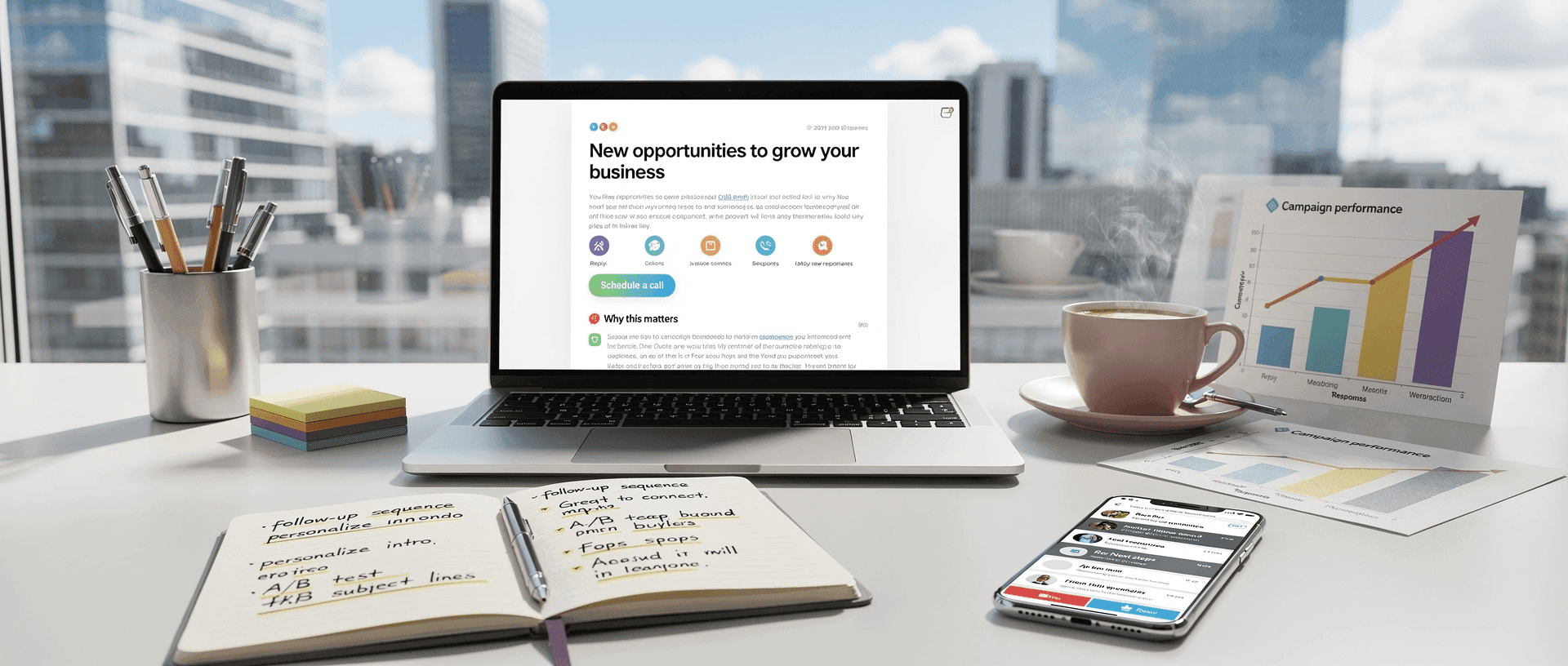
Cold email templates are pre-built outreach frameworks that give sales and marketing teams a repeatable structure for starting conversations with prospects who have never heard from them. When built right, they cut composition time by up to 70% while lifting reply rates well above the industry baseline of 1-2%.
Generic blasts get ignored. The difference between a campaign that books meetings and one that disappears into spam folders comes down to three things: the right structure, genuine personalization, and a subject line that earns the open. This guide covers all three, with 20+ ready-to-use templates, follow-up sequences, AI tools, and compliance practices to back them up.
RemoteReps, founded in 2013 by CEO Chad Castruita and trusted by 350+ enterprise brands across 40+ industries, has used these exact frameworks to deliver 3-5x ROI for clients within 60-90 days. Their SDR teams operate across 20+ countries, combining ICP clarity with structured cold email systems that turn outreach into a predictable pipeline engine.
What Makes a Cold Email Template Actually Work
Cold email templates solve a core problem in B2B outreach: starting a real conversation with someone who has no reason to respond. A well-built template includes a personalized hook, a clear value proposition, social proof, and a low-commitment call to action, all within 150 words.
Open rates for generic outreach hover around 20%. Campaigns built on tested, persona-aligned templates consistently push that number to 35-40%, according to Litmus benchmarks. Response rates follow the same curve. One-off emails written from scratch miss consistent results because there is no repeatable framework to test and improve.
Templates also create scale. A sales team sending 50 personalized emails a day from a proven framework outperforms one sending 200 generic ones. The goal is not volume; it is precision applied at volume. By aligning templates to buyer personas and specific pain points, outreach shifts from noise to a targeted signal that earns replies.
The Core Elements Every Cold Email Needs
Cold email templates only work when they include the right building blocks. Miss one and the message falls apart.
A personalized hook comes first. This is not "I hope this email finds you well." It is a specific reference: a recent funding round, a LinkedIn post, a company hire, or an industry challenge you have seen in their segment. The hook exists to prove you did your homework before hitting send.
Social proof follows the hook. A specific result from a similar company does more work than any product description. "We helped a mid-sized SaaS firm reduce churn by 22% in 90 days" is credible. "We deliver results for companies like yours" is not.
A single, low-friction CTA closes the email. "Would a 15-minute call this week make sense?" beats "Please review our offerings and let me know if you would like to schedule a demo at your convenience." One ask. One decision. Keep it easy.
Subject Lines That Drive Opens
Your subject line determines whether the rest of the email gets read. Five to seven words works best for mobile visibility. Curiosity beats promotion every time.
High-performing patterns include:
- "Quick question about [Company]'s outreach"
- "Thoughts on your recent product launch?"
- "[Mutual Contact] suggested I reach out"
- "Idea for [specific pain point]"
Avoid all caps, excessive punctuation, and words like "free" or "guaranteed" that trigger spam filters. Test subject lines in batches of 50-100, track open rates, and replace underperformers within two weeks.
Personalization at Scale
Personalization at scale requires a system. Use LinkedIn, company news feeds, and CRM data to pull one or two specific details per prospect. AI tools like Jasper or Lavender can generate personalized variations from buyer persona inputs, cutting manual research time significantly while keeping the message human.
Yesware research shows personalized emails lift reply rates by 30% over templated blasts. That gap widens further when the personalization ties directly to a pain point the prospect has publicly stated.
How to Find the Right Prospects Before You Send
No cold email template outperforms a bad list. Targeting the wrong people wastes time regardless of how strong the copy is.
Start by defining your Ideal Customer Profile (ICP). That means specifying company size, industry, tech stack, growth stage, and the exact title of the decision-maker you are targeting. A marketing director at a 50-person SaaS company has different pain points than a VP of Operations at a 500-person manufacturer.
LinkedIn Sales Navigator and Apollo.io let you filter by job title, company size, industry, and recent activity. Hunter.io and Clearbit verify contact details and reduce bounce rates. Cross-reference two data sources before importing into your CRM software, whether that is Salesforce, HubSpot, or another platform, to ensure accuracy.
Qualifying 50-100 prospects weekly is a realistic and manageable target for one SDR. Focus on companies posting about scaling challenges on social media or industry forums; those signals indicate active pain that your outreach can address directly.
Once the list is built, segment it by persona before writing. A template optimized for a CTO will not land with a Head of Marketing. Each segment gets its own hook, value proposition, and CTA. This segmentation is the foundation of any high-performing B2B cold email campaign.
B2B Cold Email Templates: 20+ Proven Frameworks With Rationale
The b2b cold email templates below are organized by use case, not by complexity. Match the framework to the scenario rather than defaulting to the same approach for every prospect.
The Quick Question Template
This template hooks the reader with a single, relevant question tied to a recent event. It signals you have paid attention, and it invites a low-effort reply.
Subject: Quick question about your recent funding round
Hi [Name],
Congrats on [Company]'s Series A. Quick question: how are you planning to scale customer acquisition over the next 90 days?
We helped similar-stage startups cut outbound ramp time by 25% with targeted outreach systems. Happy to share what worked.
Worth a quick chat?
[Your Name]
Why it works: Timely triggers like funding news produce 25% response rates in SaaS campaigns. The question is specific, not generic, and the value offer is concrete.
The Problem-Agitate-Solve (PAS) Template
This structure names a pain point, amplifies its consequences, then positions your solution as the logical fix. It works well for re-engaging dormant leads and is one of the most reliable frameworks in B2B email outreach.
Subject: Struggling with inconsistent lead flow?
Hi [Name],
Erratic lead generation is one of the fastest ways to miss quarterly targets, and in volatile markets, it compounds fast.
We have helped B2B teams stabilize pipelines by pinpointing overlooked outreach channels, resulting in 18% higher open rates for similar firms.
Would a quick audit of your current approach be useful?
[Your Name]
Why it works: Naming a specific pain point before offering a solution reduces resistance. This format consistently outperforms generic pitch emails with dormant contacts.
The AIDA Template
Four stages in one email: grab attention with a bold statement, build interest with a specific detail, create desire with proof, then close with one action. The AIDA formula is a foundational framework in sales email copywriting for a reason.
Subject: Unlock 30% more conversions with this fix
Hi [Name],
Most e-commerce teams accept 70% cart abandonment as normal. It is not.
Our clients cut that number significantly by integrating timed follow-up sequences rather than one-off blasts.
One partner reduced abandonment by 31% in six weeks using real user testimonials at the right touchpoint.
Worth 15 minutes to walk through what worked?
[Your Name]
Why it works: The emotional arc moves the reader from recognition to desire before asking for anything. Swap the social proof stat for your own client results when deploying.
The Before-After-Bridge Template
The Before-After-Bridge (BAB) framework describes where the prospect is now, where they could be, then bridges the gap with your offer. It is especially effective for prospects who are aware of their problem but not actively searching for a solution.
Subject: What your pipeline could look like in 90 days
Hi [Name],
Right now: inconsistent outreach, unpredictable meeting volume, and reps spending 40% of their time prospecting instead of closing.
After: a structured cold outreach strategy that feeds the calendar consistently and lets the team focus on high-value conversations.
We built this system for a fintech firm in [City] and saw a 3x pipeline increase in the first quarter.
Open to a quick call to map it out for your team?
[Your Name]
Why it works: BAB converts because it sells a future state, not a product. Prospects respond to outcomes more than features.
The Third-Party Connection Template
Mutual contacts remove the "who is this?" barrier immediately. Use this when you share a genuine connection with the prospect.
Subject: [Mutual Contact] suggested I reach out
Hi [Name],
[Mutual Contact] mentioned you have been working through some challenges with [specific area]. I have helped a few teams in similar positions and thought it might be worth connecting.
No pitch here, just a quick conversation if it seems useful.
[Your Name]
Why it works: Reply rates lift 20% in networking scenarios when a real referral is named. Never fabricate a connection; it destroys trust immediately.
Additional Templates by Use Case
Each of the following serves a distinct scenario. Pick based on where the prospect sits in their buyer journey, not based on what is easiest to write.
- Straight to Business: Direct value proposition with no preamble. Works for senior buyers who ignore long intros. Lifts conversions 15% in fast-moving B2B environments.
- Something Useful: Lead with a free resource tied to a specific pain point. Yields 22% engagement in content-first outreach.
- Paint a Picture: Describe a specific outcome the prospect wants. "Picture your team closing deals 35% faster" anchors the imagination before the pitch.
- Value-First Offer: Share one actionable tip before asking for anything. Opens at 28% when the tip is genuinely useful, not a disguised pitch.
- Mutual Challenge: Bond over a shared industry problem. 19% response rates in competitive markets when the challenge is framed accurately.
- Event Follow-Up: Reference a conference, webinar, or product launch the prospect attended. 24% follow-through when the reference is specific.
- Testimonial Tease: Mention a specific client win without the full case study. Drives 21% desire to learn more.
- Question + Insight: Lead with curiosity, back it with one data point. 26% replies in analytics and data-heavy niches.
- Pain Point Probe: Ask a single question about a specific challenge. Opens 17% of deeper conversations that a pitch never would.
- Success Story Share: One short story, one specific result. Builds 23% more trust than feature lists.
- Invitation to Collaborate: Propose a joint effort, co-authored content, or shared research. 20% partnership initiation rate.
- Feedback Request: Ask for input on something relevant. Creates reciprocity; 16% response lift.
- Trend Alert: Tie your outreach to something happening in their industry this week. 25% timeliness advantage.
- Personal Milestone: Congratulate a promotion, award, or company anniversary. 22% warmth-driven reply rate.
- Resource Bundle: Offer three short assets in one email. 27% value perception boost.
- Urgency Creator: Gentle deadline tied to a real reason such as limited spots or seasonal timing. 18% action prompt when the urgency is honest.
- Re-Engagement Probe: For contacts who went silent. Under 100 words, no ask, just a check-in tied to something new. Reopens 14% of dormant threads.
Advanced Qualification and Technology Behind High-Performing Outreach
Cold email templates deliver better results when backed by smart qualification infrastructure. Modern SDR teams pair strong copy with AI-powered prospect scoring to ensure every email goes to someone worth contacting.
AI-driven lead scoring tools analyze firmographic data, behavioral signals, and engagement history to rank prospects by conversion likelihood before a single email is sent. This alignment between ICP definition and AI scoring means your best templates reach your best-fit prospects, not just whoever lands on a scraped list.
Total Addressable Market (TAM) analysis plays a key role here. Knowing the full size of your serviceable market helps prioritize outreach sequencing. A company with 10,000 potential accounts needs a different email outreach strategy than one with 200. TAM analysis informs volume, targeting depth, and how aggressively to follow up across different segments.
Buyer persona development goes beyond demographics. Effective personas map to specific objections, decision timelines, preferred communication channels, and the language prospects use to describe their own problems. When cold email templates speak that language back to the reader, recognition triggers engagement. Multi-stakeholder targeting within a single account also matters. Emailing only the CTO at a mid-market company misses the VP of Engineering, the Head of Product, and the procurement lead who all influence the decision.
Open-click sentiment analysis adds another layer of intelligence. Platforms like Salesloft track not just whether a prospect opened an email, but how long they spent reading it, what links they clicked, and how their engagement pattern changed across a sequence. That behavioral data feeds directly into follow-up strategies, helping SDRs prioritize callbacks for prospects who showed genuine interest rather than just clicking by accident.
VoIP (Voice over Internet Protocol) systems have changed how SDR teams operate alongside cold email campaigns. By using VoIP for follow-up calls immediately after email opens, teams can cut average response time dramatically. Real-time call recording and analysis through VoIP platforms helps managers identify what language resonates, which feeds directly back into template refinement. Some teams report reducing call handling time by 20% after aligning their calling scripts with the messaging proven in email campaigns.
RemoteReps integrates these qualification layers into every outbound engagement. Their ICP clarity process, built over a decade serving technology, FinTech, MedTech, and e-commerce clients across 40+ industries, ensures SDRs target the right people before investing in personalization. The result is a tighter pipeline and fewer wasted sequences.
Custom CRM integrations tie it all together. When your email platform, scoring tools, and CRM share data in real time, SDRs see a complete picture of each prospect's engagement history before writing a single word. That context is what separates generic outreach from genuinely personalized cold email campaigns that earn replies.
The Right Outreach Tools and Platforms
The tools behind your email outreach strategy shape deliverability, personalization quality, and campaign measurement as much as the copy itself.
Sales engagement platforms like Salesloft and Outreach provide sequence automation, open-click sentiment analysis, and call logging in one interface. Their presence in enterprise tech stacks reflects a real coordination problem they solve: keeping email, phone, and social outreach synchronized without manual tracking. Salesloft's Rhythm feature surfaces the highest-priority actions for each rep each morning based on prospect engagement signals, which directly improves follow-up strategies by removing guesswork about who to contact next.
HubSpot's Sales Hub and Salesforce offer CRM-native email tracking that ties outreach activity directly to pipeline stages. This matters for business development teams that need to show contribution to revenue, not just activity metrics. When every email send, open, reply, and meeting booked is logged automatically in the CRM, managers can see which cold email templates produce qualified meetings and which produce noise.
Mailchimp serves email marketing campaigns aimed at warming cold prospects through content before direct outreach begins. Sending three educational emails through Mailchimp before the first cold email arrives builds name recognition. That familiarity lifts open rates by 15-20% compared to purely cold introductions.
For prospecting, Apollo.io combines contact sourcing, email sequencing, and analytics in one tool. Their database includes verified contact data for over 275 million contacts, filterable by ICP criteria. Lemlist adds image personalization and landing page integration for teams running content-heavy B2B outreach tactics. Hunter.io handles email verification, reducing bounce rates that damage domain reputation over time.
Lavender sits inside Gmail or Outlook and scores emails in real time before sending. It flags weak subject lines, measures reading level, identifies sentences that feel generic, and suggests revisions that improve email response rates. For SDRs sending 50+ emails daily, this kind of instant feedback catches problems before they reach the prospect.
Service Models That Change Cold Email Performance
Not all cold email services operate the same way. The model behind your outreach team shapes results as much as the templates themselves.
Embedded SDRs function as extensions of your internal team rather than external vendors. They join daily stand-ups, learn your product deeply, and develop brand-fluent messaging that sounds nothing like outsourced copy. This model works particularly well for complex sales cycles where prospects need nuanced, technically accurate outreach from someone who genuinely understands the product.
Exclusive agreement setters differ from shared SDR pools. When an outreach specialist works exclusively on your account, they build deeper expertise in your ICP, your competitive landscape, and the objections your prospects raise most often. That depth shows up in the emails. Prospects can sense the difference between a rep who knows your space and one running the same script for five clients simultaneously.
Performance-based pricing models align incentives between the client and the outreach team. Rather than paying flat monthly retainers regardless of results, performance pricing ties compensation to qualified meetings booked or pipeline generated. This model pushes SDR teams to refine templates continuously because their compensation depends on what actually converts.
Value propositions built for specific personas require a different approach than generic pitch copy. A VP of Sales cares about quota attainment and pipeline velocity. A CFO cares about cost per acquisition and payback period. Writing one value proposition for both audiences produces mediocre results for each. Effective cold email services build separate persona-aligned messaging for every key stakeholder in the target account.
Cold calling teams often work in parallel with cold email campaigns to create multi-touch engagement. When a prospect opens an email three times but does not reply, a well-timed call referencing the email can convert that interest into a conversation. The difference between a hot call and a cold call is exactly this context: a rep calling after tracked email engagement is warm, not cold, and should frame the conversation accordingly.
Custom CRM integrations enable this coordination. When email opens, clicks, and reply data feed directly into the CRM, calling teams see real-time signals and act on them within minutes. RemoteReps' 48-hour team deployment model means this integrated infrastructure can be operational in days, not months, a differentiator cited by clients like Vendo Commerce Director Russell Hsu, who described the engagement as "on time, on budget, on point."
Strategic Approaches to Cold Email Campaign Integration
Cold email templates do not operate in isolation. The highest-performing campaigns sit inside a broader revenue engine that coordinates email, phone, social, and paid channels toward a single pipeline goal.
Strategic multi-channel funnel approaches map prospect touchpoints across the full buyer journey. Day one: initial cold email. Day three: LinkedIn connection request referencing the email. Day seven: follow-up email with a new value offer. Day ten: phone call for engaged openers. This orchestration creates familiarity across channels without repeating the same message on every platform.
Pipeline creation and management requires clear SLA accountability at each stage. Who owns the lead after the first reply? When does an SDR hand off to an account executive? What happens to prospects who engage but do not book? Without defined handoff rules, warm leads fall through the cracks between cold email campaigns and sales conversations.
Real-time quality assurance systems ensure templates perform consistently across large teams. Daily call reviews, weekly performance dashboards, and monthly strategy optimizations form the feedback loop that keeps outreach calibrated. RemoteReps' 24/7 QA process, applied across both email and calling programs, catches messaging drift before it affects reply rates.
Multilingual support in call centers and email campaigns opens markets that English-only outreach cannot reach. For companies expanding into Europe, Latin America, or Southeast Asia, native-language cold email templates convert at significantly higher rates than translated English copy. RemoteReps' presence in 20+ countries provides this language capability without requiring clients to hire locally in each market.
AI cold calling represents the next evolution of multi-channel integration. AI systems that handle initial prospecting touchpoints, qualify interest, and pass engaged prospects to human SDRs can run 24/7, generating pipeline while the sales team sleeps. RemoteReps' AI-driven prospecting delivers 85% cost reduction compared to traditional SDR models, with 2-3x pipeline generation for clients in technology and SaaS.
Revenue engine alignment connects cold email performance to downstream metrics. Open rates and reply rates matter, but the real measurement is qualified meetings booked, pipeline value created, and deals closed. Campaigns that produce high open rates but few qualified meetings need different fixes than campaigns with strong reply rates but poor meeting quality. Tracking the full funnel from first email to closed deal reveals where the real bottlenecks live.
Follow-Up Sequences That Convert
Follow-up emails turn one-shot outreach into a sustained conversation. Woodpecker research shows structured follow-up sequences boost responses by 21% over single-touch campaigns. Most decision-makers are not ignoring your email out of disinterest; they are managing 200 other priorities when it arrives.
How Many Follow-Ups to Send
Three to five follow-ups per sequence is the effective range. Send the first follow-up three days after no reply, then space subsequent messages four to seven days apart. Exceeding five touches risks irritating the prospect and burning the contact permanently.
Each follow-up should add new value rather than repeating the original ask. The first email introduces a problem. The second shares a relevant resource. The third references a case study. The fourth makes a direct meeting request. This layered approach keeps the prospect engaged without feeling like a collection notice.
Post-Meeting Recap Template
Subject: Quick recap from our call on [Specific Topic]
Hi [Name],
Thanks for the conversation last week on [specific challenge discussed]. Here are the three takeaways we landed on:
- [Actionable insight from the call]
- [Potential outcome if implemented]
- [Proposed next step]
Does this align with your priorities for Q[X]? Happy to move forward on [specific action].
[Your Name]
This format recaps value while prompting the next decision without pressure.
Re-Engagement for Cold Leads
For prospects who went silent, drop the sales pitch entirely. Send a short note under 100 words with a genuinely useful offer: a free audit, a relevant article, or a question about a recent industry development. No ask. No urgency. Just a signal that you are still paying attention.
Review past interactions before sending. If a prospect opened three emails but never replied, the issue is likely timing or priority, not interest. A re-engagement note that acknowledges the silence and offers something new reopens the conversation without pretending it never stalled.
Real-World Results from Cold Email Campaigns
SaaS Startup Triples Pipeline with PAS Outreach
A SaaS company targeting mid-sized tech firms was seeing reply rates below 5% on standard outreach. They rebuilt their templates around the PAS framework, pulled funding news and integration pain points from prospect profiles, and used AI tools to generate personalized variations for each segment.
Reply rates climbed to 28%. The sales pipeline tripled within three months. The key shift was specificity: every email named a real problem the prospect was publicly dealing with rather than describing product features.
E-Commerce Brand Lifts Conversion Rates by 45%
An online retailer targeting dormant customers combined the "Something Useful" template with a multi-channel follow-up sequence. The initial email offered a practical tip on eco-friendly packaging tied to each recipient's purchase history. Follow-ups addressed cart abandonment with specific friction-reduction ideas.
Conversion rates lifted 45% over six weeks. Twelve percent of re-engaged contacts placed repeat orders within 30 days.
B2B Consulting Firm Books Meetings Through Referral Outreach
A professional services firm in finance built a campaign around the third-party connection template. Every email opened with a mutual contact reference and closed with a compliance-specific insight tied to current regulatory changes.
From 200 emails sent, 15 qualified meetings were booked, a 7.5% meeting rate against an industry average closer to 2%. Virtual Dental Care COO Dr. William Jackson described a similar outreach-first approach through RemoteReps as "a genuine team extension," one that felt integrated rather than outsourced.
Cold Email Templates 2026: What's Changing and What Still Works
The core mechanics of cold email have not changed: a specific hook, a credible value proposition, and a low-friction ask still drive replies. What has shifted heading into 2026 is the infrastructure around those fundamentals.
AI-generated personalization has become table stakes. Prospects in technology, SaaS, and professional services receive dozens of AI-assisted emails weekly. The ones that cut through are built on behavioral triggers and real company context, not just name and company fields swapped into a generic template. Cold email templates 2026 that perform well combine AI efficiency for list building and variation generation with human judgment for the actual messaging.
Inbox placement has also gotten harder. Google's and Microsoft's filtering algorithms now evaluate sender reputation, engagement history, and content patterns simultaneously. Warming new domains before launching sequences, maintaining bounce rates below 2%, and sending from individual rep mailboxes rather than shared marketing addresses have shifted from best practices to requirements.
The B2B buyers receiving these emails have also changed. Buying committees at mid-market and enterprise companies now average six to ten stakeholders. A single cold email to the VP of Sales is rarely sufficient. Sequences that touch the economic buyer, the technical evaluator, and the end user simultaneously with persona-specific messaging convert at nearly double the rate of single-thread campaigns.
What remains constant is the value of genuine personalization tied to a prospect's actual situation. A cold email template that references a company's recent product launch, a hiring trend visible on LinkedIn, or a public pain point the CEO mentioned in a podcast will always outperform one that relies on merge fields alone. The research required to make that happen is the one thing AI tools still cannot fully replace, which is exactly where skilled SDRs create durable competitive advantage.
RemoteReps' teams, serving clients across Technology, FinTech, MedTech, and e-commerce for over a decade, have tracked these shifts in real time. The 50,000+ vetted professionals in their network apply updated qualification practices quarterly, ensuring outreach stays ahead of filtering changes and prospect expectations rather than catching up to them.
Compliance, Ethics, and Cold Email Best Practices
Cold email campaigns live or die on deliverability, and deliverability depends on compliance. Violating CAN-SPAM or GDPR does not just risk fines up to €20 million; it gets your domain blacklisted, which kills every future campaign.
Staying Compliant
Every cold email must include a clear unsubscribe link and a physical mailing address. CAN-SPAM requires honoring opt-outs within 10 business days. GDPR requires documenting legitimate interest for B2B outreach and avoiding sensitive personal data in list building.
Audit campaigns quarterly: check bounce rates, monitor spam complaints, scan subject lines for trigger words, and verify all contact data was sourced legally. Email marketing compliance is not optional; it is the foundation that keeps the channel viable.
RemoteReps' SOC 2, ISO 27001, GDPR, and CCPA certifications reflect the enterprise-grade compliance standards their teams apply to every outbound program. For companies sending outreach at scale, working with a partner that carries these certifications reduces regulatory risk significantly.
Essential Tools for Cold Email Outreach
GMass: Bulk Gmail integration for up to 10,000 emails daily with personalization intact.
Hunter.io: Domain-based contact sourcing that reduces invalid addresses by up to 90%.
Lemlist / Woodpecker: Sequence automation with A/B testing built in, ideal for refining follow-up strategies over time.
Lavender: AI-powered email scoring that flags weak subject lines and low-engagement body copy before you send.
Apollo.io: ICP-aligned prospecting with verified contact data and filtering by firmographic criteria.
Compliance Checklist Before Every Campaign Send
- Verify all email addresses against a validation tool
- Confirm unsubscribe link is visible in the footer
- Check subject line for spam trigger words
- Document data source for each contact
- Confirm opt-out requests from prior campaigns are honored
Wholesale Distribution Company CEO Ben Osmanson credited RemoteReps' structured outreach systems with generating "50% of revenue," a result that starts with disciplined compliance and ICP-aligned targeting.
Putting Cold Email Templates to Work
Cold email templates work when they combine the right structure, genuine personalization, and disciplined follow-up into a repeatable system. The 20+ templates in this guide provide a starting library. The qualification frameworks, multi-channel approaches, and compliance practices provide the infrastructure to scale what works.
Start with one template matched to your highest-priority ICP segment. Test the subject line with 50 sends. Measure opens, replies, and meetings booked, not just opens in isolation. Refine the hook based on what your best-performing emails have in common. Build from there.
The teams that consistently outperform in cold outreach are not the ones with the cleverest copy. They are the ones with the clearest ICP, the most disciplined testing cadence, and the most honest measurement of what the emails actually produce downstream. Subject line optimization, persona alignment, and structured follow-up sequences are not one-time tasks; they are the ongoing work that separates campaigns that book meetings from campaigns that fill trash folders.
Related Services and Guides
Powered by people, boosted by AI
Turn this playbook into booked meetings
Talk to a strategist and walk away with a tailored pipeline plan. Dedicated, managed reps, live in 1-2 weeks.